
The Alaska Department of Transportation & Public Facilities (DOT&PF) recognizes the deep cultural heritage and unique needs of Alaska Native peoples and Alaska Native organizations. The DOT&PF Tribal Relations Team was established to strengthen collaboration, foster mutual respect, and build lasting relationships between the department and Alaska Native organizations. Our goal is to create a meaningful, transparent, and inclusive engagement framework that ensures tribal voices are heard and integrated throughout Alaska's transportation planning and infrastructure development processes.
The Tribal Relations Team is part of the broader TransportationX initiative, which prioritizes stakeholder engagement across the state's diverse communities. By updating policies, facilitating targeted training, and providing support for meaningful consultation, we are working to bridge the gap between state transportation objectives and local priorities of Alaska Native communities. Our work aligns with state and federal legal requirements and reflects our commitment to honoring and preserving Alaska's rich Indigenous heritage.
Alaska DOT&PF developed a draft policy, updating the 2002 version, to strengthen how we consult and build long-term relationships with Tribes—ensuring that future work is guided by respectful, effective engagement and reflects the priorities of Alaska Native communities.
The most critical phase is now underway with a 45-day Tribal review period from March 27, 2026, through May 11, 2026. As a Tribe, Alaska Native Corporation, or Tribal leader, participation is essential to ensuring the policy reflects a meaningful and practical way of working.
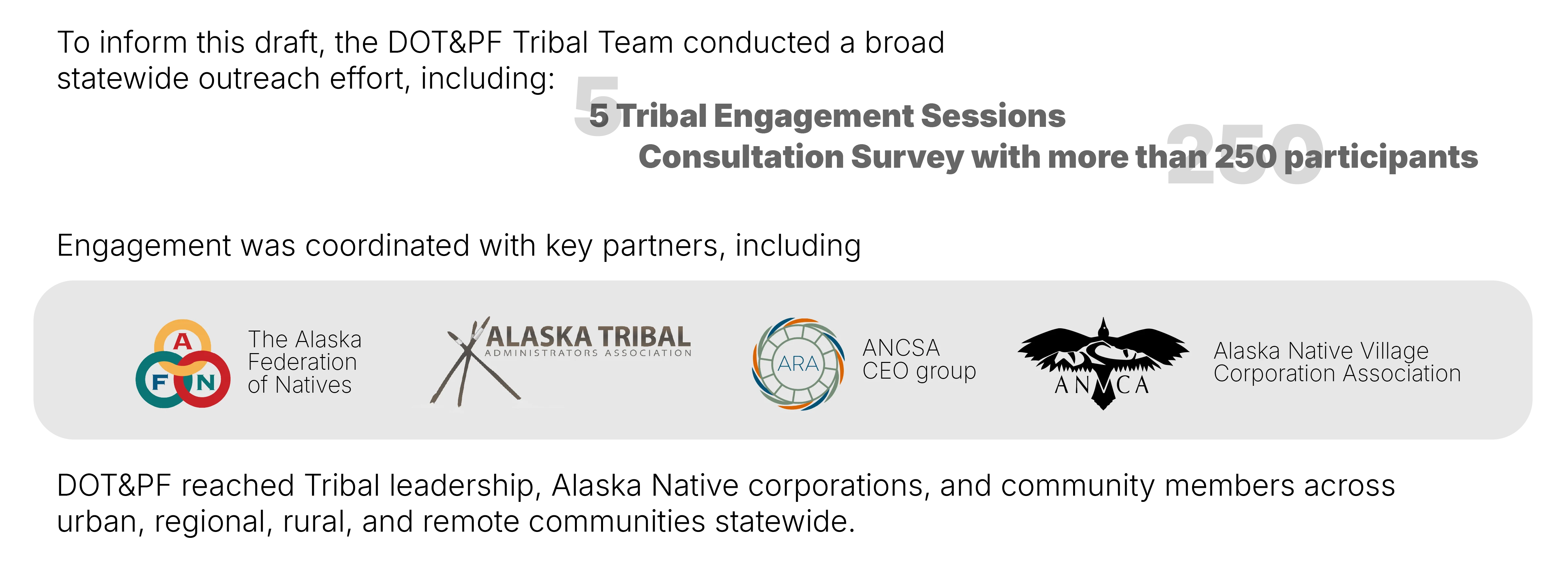
To inform the policy, the DOT&PF Tribal Team, in partnership with the Alaska Native Chamber, conducted a broad statewide outreach effort, including five Tribal engagement sessions and a consultation survey conducted in June 2025 and January 2026 with more than 250 participants. Engagement was coordinated with key partners, including the Alaska Federation of Natives, Alaska Tribal Administrators Association, ANCSA CEO group, and Alaska Native Village Corporation Association, and reached Tribal leadership, Alaska Native corporations, and community members across urban, regional, rural, and remote communities statewide.
This outreach was not required by statute but was an intentional step to ensure perspectives shared through prior engagement and survey responses were accurately heard and understood. The goal was to reflect those insights in a policy that supports a practical and respectful way of working together.
DOT&PF is providing a 45-day Tribal review period beginning March 27, 2026 and concluding May 11, 2026.
Comments may be submitted through this Public Input site,an online platform where participants may review project materials and submit comments directly. Comments may also be submitted by:
If you would like to provide additional information or comments outside of the Public Input Website, please email the DOT&PF Tribal Team at dot.tribal.team@alaska.gov. lf you would like to speak with someone from the team, connect with Danielle Tessen at 907-347-8358.
The continuously evolving DOT&PF Tribal Team works statewide to build strong partnerships with Tribes, collaborating across agencies to support meaningful engagement and coordinated project delivery.
The team has led the update of the Statewide Tribal Consultation Policy—originally adopted in 2002—through extensive outreach and a statewide survey conducted between June 2025 and January 2026. This effort included engagement at conferences, coordination meetings, and targeted sessions with Tribal leaders, ANCSA corporations, and partners across Alaska, helping shape a draft policy that reflects both cultural expectations and federal requirements.
In addition, the team has developed Training Modules and a Tribal Engagement Resource Library to ensure consistent, informed, and lasting practices across the department.
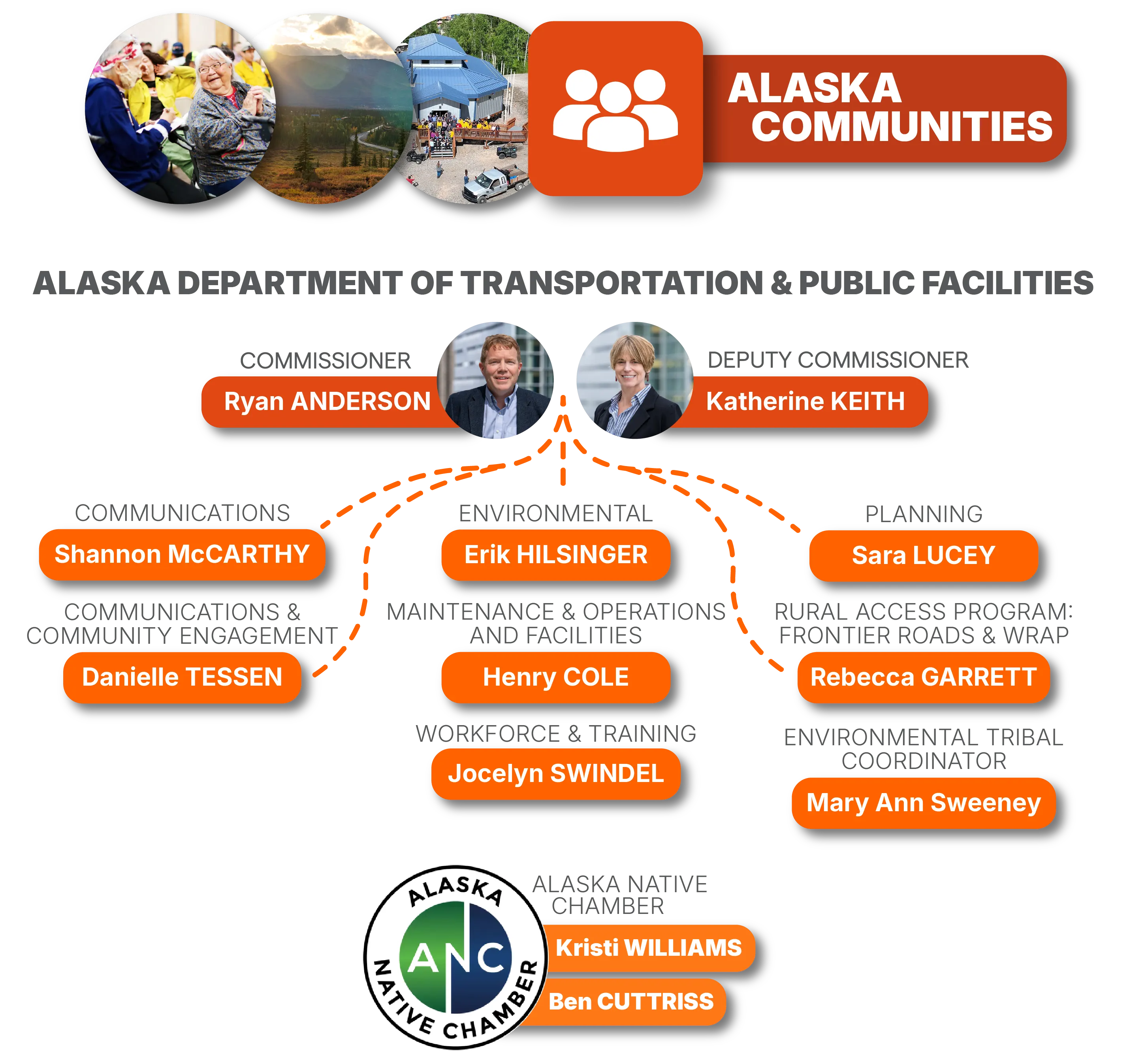
The DOT&PF Tribal Team uses a coordinated, cross-agency approach to connect leadership, divisions, and Tribal partners across Alaska. The team strengthens the department through Tribal policy updates, internal training, and a shared resource library—equipping staff statewide to deliver consistent, informed engagement and community-driven projects.
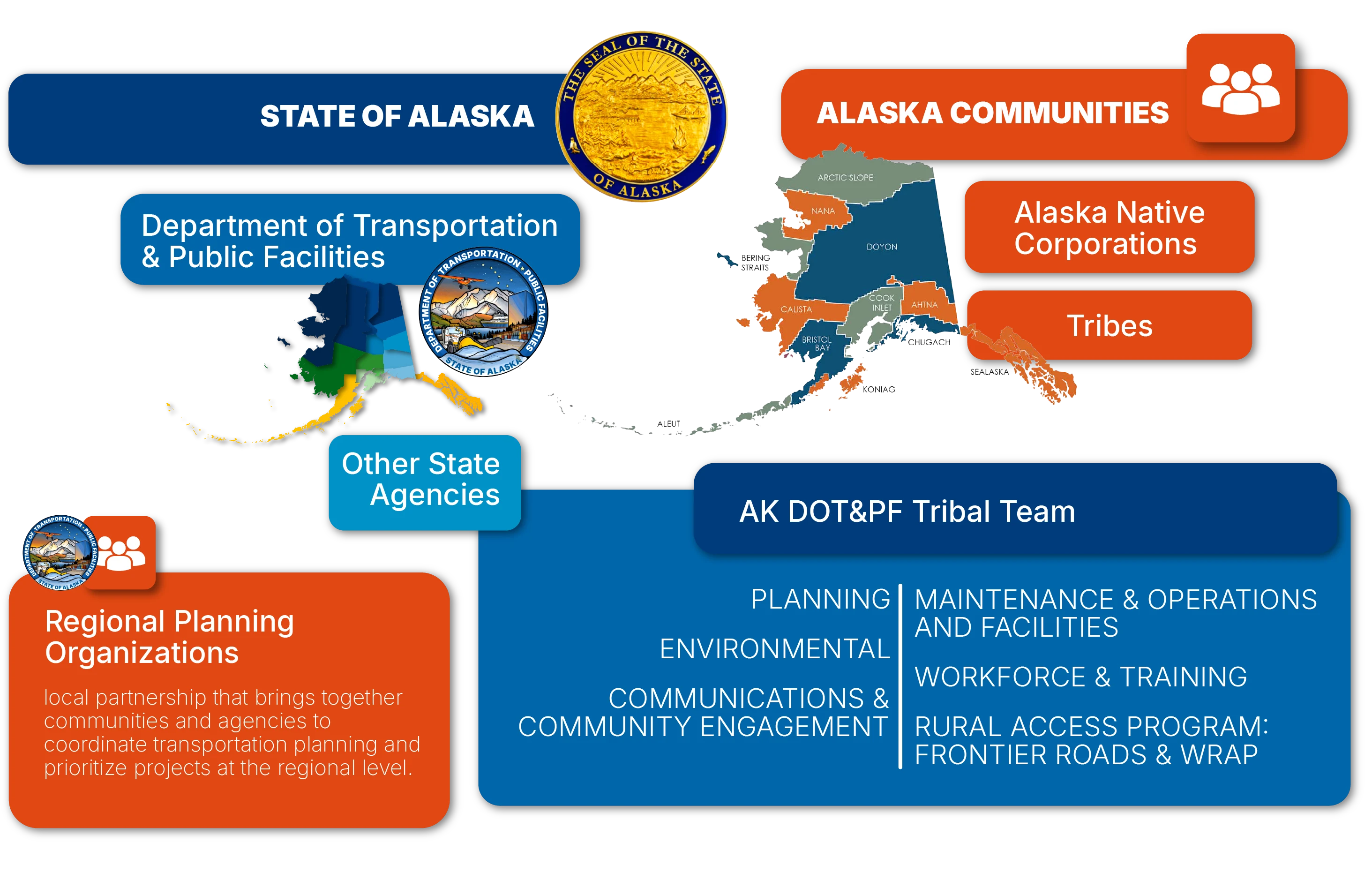
The DOT&PF Tribal Team operates as a central connector by linking state agencies, regional planning organizations, and Alaska communities, including Tribes and Alaska Native corporations. By integrating planning, environmental, communications, maintenance, workforce, and rural access programs, the team ensures transportation priorities are coordinated across partners and grounded in community needs.
This video supported a statewide outreach effort, including 5 Tribal engagement sessions and a survey with 250+ participants, to inform the Tribal consultation policy.
Dear Tribal Leader,
Strong, respectful relationships with communities are essential to successful transportation investments across Alaska. We are rebuilding how we work with Tribes because we believe strong partnerships lead to better outcomes—for infrastructure and for the people we serve. To support that, we're creating systems that help our employees go beyond regulatory requirements to build long-term relationships with communities.
The strongest projects are guided by the people who live alongside them. Whether it's a road, ferry terminal, airport, port, or trail, working directly with communities delivers projects faster, with fewer impacts, and in ways that serve a meaningful purpose for generations because they reflect local priorities from the very beginning.
The Alaska Department of Transportation & Public Facilities is working with the Alaska Native Chamber to strengthen our consultation practices. This effort will help create a framework that centers Alaska Native voices in decisions about planning, construction, and maintenance of transportation infrastructure.
SHAPE THE PROCESS
Your input will shape staff training materials, consultation guidelines, and partnership protocols for future transportation projects. We would like your guidance to inform Alaska's transportation planning, development, and construction processes by sharing what consultation approaches have worked well—whether from our department or other organizations.
We invite you to share your insights on what effective consultation looks like.
Download the Tribal Relations Survey Letter to share your feedback.
You may also send comments to info@alaskanativechamber.com or call the Alaska Native Chamber at (907) 201-2626 to speak with a representative.
Thank you for your time, leadership, and continued partnership.
Alaska DOT&PF Tribal Team
The Hughes Sunny Lane project stands as a successful example of community-led transportation, demonstrating how small, rural communities can come together to complete vital infrastructure projects. Hughes, a remote Alaskan community with approximately 85 year-round residents (2020 Census), faced a long-standing challenge—safe and reliable access to its traditional cemetery, which was previously only reachable by boat or by climbing a steep riverbank using ropes. Now, with the completion of the 2.4-mile gravel Sunny Lane Road, residents can access the cemetery year-round, ensuring a safer and more dignified route for families visiting their loved ones.
Beyond its primary purpose, Sunny Lane has transformed community life in Hughes. The road has opened new opportunities for outdoor recreation, making dog mushing, walking, hiking, jogging, and biking more accessible and enjoyable. Additionally, the project has enhanced wildfire preparedness by creating a critical fire-break and improving fire-watch and fire-fighting access to the dense woodlands east of the community.
A key component of this project was workforce development, providing hands-on heavy equipment training and construction experience to local residents. Through this effort, men and women in Hughes received training in road construction, equipment operation, and project management—skills that will serve the community for years to come. Not only did the project create paying jobs, but it also helped establish a trained workforce capable of maintaining and improving local infrastructure into the future.
The completion of the Hughes Sunny Lane project serves as a model for other rural communities seeking to develop community-led transportation solutions. By investing in workforce training and leveraging local resources, small communities can successfully tackle essential infrastructure projects, strengthening both their economies and their residents' quality of life.
Questions? Want to reach out to Alaska DOT&PF about an idea? Please send us an email by selecting the box below.