
Fatality Analysis Reporting System (FARS)
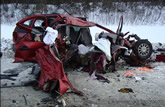 Photo courtesy of the Alaska State Troopers. |
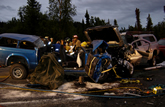 Photo courtesy of the Alaska State Troopers. |
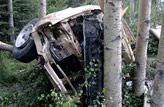 Photo courtesy of the Alaska State Troopers. |
Since 1975, the National Highway Traffic Safety Administration (NHTSA) has operated and maintained the Fatality Analysis Reporting System (FARS). FARS is a national data collection system that contains information on all known motor vehicle traffic crashes in which there was at least one fatality. For the purposes of the FARS program, a reportable fatality is a death that occurs within 30 days (or more precisely, 720 hours) of the motor vehicle traffic crash and is a direct result of the crash. Initial identification of fatalities under FARS often comes from police crash reports but may come from any available source. Detailed information on the circumstances of the crash and persons and vehicles involved are obtained from a wide variety of sources including police crash reports, driver licensing files, vehicle registration files, state highway department data, emergency medical services records, medical examiner/coroners reports, toxicology reports, and death certificates.
FARS is an important resource for NHTSA, the states, and the traffic safety community. The FARS data, a census of all fatal motor vehicle traffic crashes in the U.S., helps NHTSA and others understand and describe the national and state traffic safety environment. FARS data are used to identify problem areas, evaluate safety countermeasures, and to facilitate the development of traffic safety programs at the national, state, and local levels. FARS data provide a basis for Agency decisions in traffic safety, crash worthiness research, and rulemaking. In addition, the consistency of definitions for data in FARS allows an individual state or geographical area to assess its traffic safety situation in relation to the national experience and that of other states.
The FARS data are gathered, interpreted, coded and entered into the National Database in each state by FARS Analysts. The Analysts are employees of state government agencies under agreement with NHTSA for the support of the FARS program. The number of FARS Analysts differ by state according to population and number of fatalities. Alaska has one FARS Analyst.
Fatality Analysis Reporting System (FARS) Data
NHTSA's Fatality Analysis Reporting System, or FARS, contains data on every fatal traffic crash in the 50 States, the District of Columbia, and Puerto Rico. To explore Alaska's fatal crash data up to 2021, please explore the links below:
Data Visualization - FARS
This portal presents interactive visualizations that focus on several highway safety topics of interest. These visualizations include multiple dashboards with information on fatal motor vehicle traffic crashes and fatalities.
FARS Data Tables
This link presents data tables containing fatal crash and fatality statistics from 1994-2021.
Fatality and Injury Reporting System Tool (FIRST)
This query tool allows a user to construct customized queries from the Fatality Analysis Reporting System.
Related Links
Safety Topics
- DEC / DRE
- Distracted Driving
- Fatality Analysis Reporting System (FARS)
- Headlights
- LEL - Law Enforcement Liaisons
- Low Speed Vehicles
- Media Campaigns
- Mock Crashes
- Moose Safety
- Occupant Protection
- REDDI
- Safe Communities
- DUI Information & Impaired Driving
- Safety Corridor
- Senior Driving in Alaska
- Teen Driving in Alaska
- Snowmobiles and ATVs
- Traffic Records
Please note: You must have Acrobat Reader to open any  documents on this page. If you do not have Acrobat Reader, click to download the FREE software.